Abraham Lincoln, open windows and supposed ethical lapses. - Mark P. Loftus
Saw an excellent article in the Illinois Bar Journal by lawyers Guy Franker and J. Steven Beckett entitled Lawyer Lincoln’s Legacy – Honest Abe on Lawyer Honesty. Their article offered an interesting analysis of a supposed ethical lapse Mr. Lincoln had whilst defending a woman on murder charges. Before going much further, let me state that both Mr. Franker and Mr. Beckett have likely forgotten more about Mr. Lincoln than I will ever know. Similarly, I would wager they have a much more comprehensive understanding of Rules of Professional Conduct than I. But what the hell….
By way of background, in 1857, Lincoln was defending Melissa Goings, a 70 year old woman on murder charges. The case was tried in Metamora, Illinois, outside Peoria. Mr. Goings apparently beat his wife on a fairly regular basis. His last attempt to beat his wife did not end well for him. Melissa decided she had endured enough and grabbed a piece of firewood to protect herself. She struck her husband in the head with the firewood and Mr. Goings died. Ms. Goings was then charged with murder.
The trial, according to the article was presided over by Judge James Harriott. Again, according Mr. Franker and Mr. Beckett, Judge Harriott was doing all he could to insure a Guilty verdict. Lincoln requested a brief recess. He and Melissa walked to a first floor conference room where Melissa requested a drink of water. Lincoln opened a nearby window and advised his client there was good water in Tennessee. Lincoln then made his way back to the Courtroom – alone – and acknowledged that conversation. Not surprisingly, Ms. Goings disappeared. The following year, Lincoln convinced the State’s Attorney to drop the pending charges.
The authors conclude that Lincoln, in effect, abetted the escape of his client. Apart from Lincoln and Ms. Goings, however, no one will ever know precisely what happened in that small conference room. Maybe Lincoln made an off-handed remark that his client misconstrued. Maybe Lincoln left the room for a moment and Melissa scurried out the window. Perhaps Melissa, knowing she was being railroaded, had already decided to flee and was simply looking for the first opportunity. Without more, it seems a bit unfair to suggest Lincoln, on the basis of one remark, facilitated an escape.
The authors then conclude that Lincoln failed to act in the furtherance of justice and had an ethical lapse. And they cite to today’s rules, which, based on my admittedly rudimentary research skills, weren’t committed to writing until the 20th Century.
The year was 1857. Women were still second class citizens and wouldn’t secure the right to vote for another 63 years. Ms. Goings had been regularly abused by her husband. She finally said enough and defended herself – striking her husband just twice, according to court records. Under the current law, it seems unlikely most prosecutors would even consider a murder charge. But in what was then very rural Illinois, a husband lay dead and his wife was holding a bloody piece of wood. That added up to murder and the subsequent trial would amount to window dressing.
To make matters worse, Goings ended up before a judge who had presumptively decided she was guilty. Lincoln’s considerable trials skills were of little use. The death penalty was alive and well in Illinois in 1857. Ms. Goings was likely going to be convicted. And then she would be hanged.
Perhaps Lincoln did open that window. And maybe he did comment on the delicious water in Tennessee. By doing so, he prevented the murder conviction of an elderly, battered woman by a biased judge. And Lincoln saved the life of a woman who didn’t deserve to die. In the preamble to the current Illinois Rules of Professional Conduct, there is language that lawyers are supposed to “challenge the rectitude of official action.” Lincoln, always ahead of his time, was doing just that when he cracked that window.
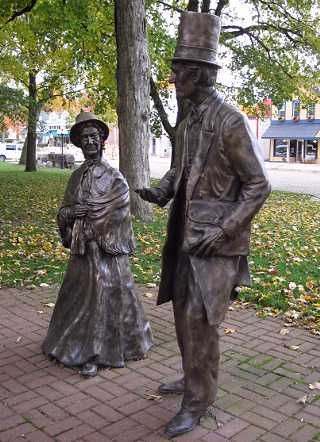
The statute above, in Metamora, Illinois depicts both Lincoln and Goings. It is not often that ethical lapses are memorialized in bronze.