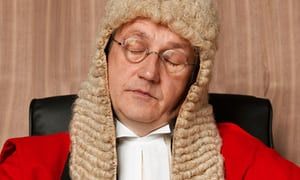
Judge sleeps during a murder trial and Illinois Appellate Court is fine with it. - Mark P. Loftus

September 26, 2025

Imagine a criminal trial where the defendant is charged with four separate counts of first degree murder. Then imagine that while a detective is testifying regarding some videotape evidence, defense counsel notices that the judge is ….. asleep. Sounds like the opening scenes from Law and Order. But that exact scenario played out in a Whiteside County, Illinois courtroom not long ago. The saga is detailed in this Appellate Court opinion – People v. Sheley, 2017 IL App (3d) 140569 -.

After the videotape concluded, defense counsel noticed the judge was sleeping. Defense counsel then woke the judge. Shortly thereafter, defense counsel properly made his record, where he noted that the judge – Judge Jeffrey O’Connor – had fallen asleep. The Appellate Court opinion indicates that defense counsel noted that he had observed Judge O’Connor sleeping before, but the specifics are not provided. The State’s Attorney, acknowledged on the record that he too had observed the judge sleeping. Judge O’Connor didn’t deny falling asleep. He simply commented that he had no physical issues the might impair him and allowed the trial to move forward.

The next day the defense appropriately asked for a mistrial because O’Connor had been falling asleep. The motion was denied and the defendant was convicted. The defense sought a new trial, citing the fact the judge had fallen asleep more than once, and appeared to be confused. O’Connor’s ruling on that motion is a study in deflection. First, he noted, apparently in his defense, that he only fell asleep once. O’Connor then goes on to voice his displeasure with the fact that the local press had the nerve to point out that he had fallen asleep during a murder trial. O’Connor characterized the motion as “disgusting” and denied it. The defendant appealed the guilty verdict.

The Third District Appellate Court didn’t exactly meet the moment. Right out of the gate the Appellate Court shrugged. The opinion noted that the mere fact the guy in charge of things is unconscious is not quite enough. Instead, the defendant has to show he was somehow prejudiced. The Appellate Court then noted that while the video was being played there were no objections made. Does the Appellate Court really wish to suggest that as long as the judge isn’t called upon to actually do something he can continue sleeping? I hope not.

And the opinion only gets worse. In a concurring opinion, one of the Appellate Judges ignores the issues and takes a cheap shot at defense counsel – declaring the lawyer waited to object in an effort to “sandbag” the judge. Good Christ. A judge falls asleep during a murder trial and and you go after the lawyer?

There was one bright spot in an otherwise immensely disappointing decision. In a dissent, Judge O’Brien noted that when a judge is asleep, that judge, by definition, loses control of his courtroom. He can’t rule on objections or stop any objectionable conduct. O’Brien argued that a sleeping judge threatens a defendant’s right to a fair trial. Additionally, O’Brien noted that by falling asleep during testimony, the judge in effect, is telling the jury that testimony is not important. But one judge out of three doesn’t carry the day. The trial court verdict was affirmed. Not a great day for the Third District.


Red Tesla sedan driving on a road.
September 26, 2025
According to online reports, Tesla ignored a $60 million dollar settlement overture in the wrongful death case that ultimately resulted in a $242 million dollar jury verdict against the car maker. The lawsuit grew out of 2019 crash where a Tesla Model S with Autopilot engaged, plowed through a Florida intersection and crashed into a Chevy Tahoe. Neima Benavides Leon and her boyfriend, Dillon Angulo were standing near the Tahoe when the Tesla crashed into it. Leon was killed and Angulo suffered serious injuries. A lawsuit was filed against Tesla, asserting that although the Autopilot feature was engaged, the vehicle did not brake. Florida law permits a monetary demand to be issued before trial. If the defendant fails to accept the demand within 30 days it is considered rejected. If the plaintiff then goes to trial and secures a verdict 25% greater than the offer, the defendant is on the hook for plaintiff’s investigative expenses and attorneys’ fees. Tesla is appealing the jury verdict, citing “substantial errors of law and irregularities at trial.”.
Johnson's baby powder container, white bottle, blue text, red seal, 400g.
September 26, 2025
This important ruling got kind of lost in the news cycle. A couple weeks ago, the United States Supreme Court refused to vacate a $2.2 billion dollar ovarian cancer verdict against Johnson & Johnson[“J & J”]. The verdict was originally returned by a Missouri jury in 2018 on behalf of 22 women. The original verdict was actually $4.7 billion but a Missouri Appellate Court reduced the award to $2 billion. Each of the women claimed that there was asbestos and asbestos-laced talc in J & J talcum powder products they used, and they developed ovarian cancer as a result. Asbestos is known to cause cancer. Talc, in its raw form is often found in close proximity to naturally occurring asbestos. When J & J mined talc, that talc sometimes contained asbestos. And that asbestos sometimes found its way into J & J personal hygiene products. [In 2019, J & J recalled 33,000 bottles of J & J products after FDA testing found asbestos in test samples]. J & J, has known of the risk of asbestos contamination in talc products since the 1970’s. Some 21,000 plus ovarian cancer cases are pending against J & J throughout the United States.
Movie poster for
September 26, 2025
Reports today say that DuPont and the State of New Jersey have reached a $2 Billion dollar settlement arising out of DuPont’s release of “forever chemicals” into soil, wetlands and other areas in New Jersey – and then forgetting to clean up the mess they made. The settlement with DuPont is reportedly the largest environmental settlement ever obtained by a state. “Forever chemicals” – also known as PFAS(referring to per and polyfluoroalkyl substances) are man-made chemicals that are used in an extensive variety of products as they are both water and grease-resistant. The chemicals are linked to litany of health problems, including increased risk of certain cancers(kidney, testicular and breast) liver damage, thyroid issues and reproductive problems(such as decreased fertility, low birthweight and developmental problems). NJ.Com is reporting that one of the sites where DuPont created munitions created such significant contamination in the environment that over 300 homes required filters to prevent toxic chemicals from seeping into their homes. The settlement terms provide that DuPont will spend $875 millions cleaning up the contamination and set aside another $125 million to cover other damages that may arise. Additionally, DuPont will also set p a $1.2 billion funding source and reserve fund of $475 million to ensure that even if the company fails to make payments, or goes bankrupt, public funds will not be used. For a stark introduction into the nature of PFAS, check out Dark Waters, a compelling and criminally underrated movie based on the decades old fight waged by attorney Robert Bilott against DuPont for contaminating West Virginia rural communities.