Young workers dying from incurable disease associated with stone countertops - Mark P. Loftus

September 26, 2025

The Los Angeles Times had a disturbing article by Emily Alpert Reyes last week regarding the deadly illness popping up among workers involved in the cutting of manufactured stone for use in kitchen countertops. The illness – silicosis – is an incurable and suffocating disease that is killing workers across California – many of them quite young. The article details how engineered stone – the material of choice in kitchen countertops – has a higher concentration of silica than natural stone. When workers cut the stone without appropriate protection, tiny particles of crystalline are expelled into the air. Those workers then unknowingly inhale the silica particles. Over time, the silica dust particles cause inflammation in the lungs that leads to the formation of lung nodules and scarring in the lungs known as pulmonary fibrosis. Once afflicted the lung capacity decreases, followed by shortness of breath, lung failure, and eventually death. Historically silicosis took 10-30 years to develop. But pulmonary physicians, who normally see silicosis patients in their 60’s and 70s are now seeing an alarming number of patients in their 20s, 30s and 40s. Dr. Jane Fasio, a pulmonary critical care doctors at Olive-View UCLA Medical center noted “They’re young guys who essentially have a terminal diagnosis.”

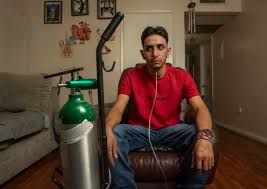
Reyes talked to young predominantly Hispanic workers who cut, polished and installed countertops in and around Los Angeles. The workers detailed how dust was everywhere and few, if any protections were given to the workers. Leobardo Segura Meza, only 27, described how he has to hustle home from the park with his young kids – before his oxygen tank runs out. Meza knew of two co-workers who had already died of silicosis, while waiting for lung transplants.

Non-profit groups such as Pacioma Beautiful are sending volunteers to local industrial parks to warn workers of the dangers. Unfortunately many of the workers are day laborers, and have little knowledge of the disease, and, due to economic hardship, take stone work positions in facilities that offer little, if any protection against airborne silica. “Wet saws” – saws that spray water onto the stone to minimize airborne particles and NIOSH respirators are the two primary measures that companies can offer to workers as a way to minimize foreign particle inhalation. But many smaller shops lack the budget, or conscience, to make those means available.

And the risk to workers is very real. Reyes notes that 1 in 5 Australian stone workers have the disease. Workplace safety regulators in California estimate that approximately 12-20% of the 4000 industry workers in California have silicosis. A recent study of California workers with the disease revealed a death rate of nearly 20%, with the median age at death only 46.

While California safety regulators are now drafting emergency safety rules to protect workers, some lawyers representing sick workers feel engineered stone is simply too dangerous to be used safely, and have called for a ban of the product.

Engineered stone is the predominant material used in countertops. And its popularity is expected to increase.


By Mark Loftus February 17, 2026
German Conglomerate makes a bid to end Roundup litigation 
By Mark Loftus February 17, 2026
By Mark Loftus February 3, 2026
THE ILLINOIS GENDER VIOLENCE ACT - IN A NUTSHELL Under the Illinois Gender Violence Act (GVA) 740 IlCS 82/1, victims of sexual assault, domestic violence and other forms of gender related violence can bring civil actions against perpetrators even when criminal charges are not filed. The GVA defines two of the four acts of “gender violence” - though the definitions are a bit convoluted: One or or more acts of violence of physical aggression satisfying the elements of battery under the laws of Illinois that are committed, at least in part, on the basis of a person’s sex; A physical intrusion or physical invasion of a sexual nature under coercive conditions satisfying the elements of battery under the laws of Illinois, whether or nor the act or acts resulted in criminal charges, prosecution or conviction. Under the Illinois Criminal Code, a person commits a battery when he or she knowingly, without legal justification, causes bodily harm or makes insulting/provoking physical contact with another individual. 720 ILCS 5/12-3. The Criminal Code requires physical contact. AND EMPLOYERS MAY NOW FACE LIABILITY In July, 2023 an amendment made it explicit that the GVA does extend to the workplace. As set forth in the Act, an employer is liable for gender-related violence in the workplace by an employee when the interaction arises out of and in the course of employment. Liability will only arise however, if the (1) the employee was directly performing his or her duties and the violence was the proximate cause of the injury or (2) while the agent of the employer was directly involved in the gender-related violence and the performance of the work was the proximate cause of the injury. Liability will only extend to the the employer however if it can be shown that (1) the employer failed to supervise, train or monitor the offending employee or 2) the employer failed to investigate and respond to reports directly provided to appropriate management personnel. Damages under the Act may include injunctive relief, and actual damages, damages for emotional distress and punitive damages. And importantly, the GVA is a fee-shifting statute - so a successful plaintiff may seek to recover attorneys fees. So, in cases of sexual harassment, may a plaintiff, include a count for damages under the GVA? The answer is an unqualified yes. And the contact need not be excessive or dramatic or prolonged - so long as there was no consent nor any justification for the physical contact. In fact, the Act notes that a legitimate threat that the harasser will commit an nonconsensual act is sufficient.
Red Tesla sedan driving on a road.
September 26, 2025
According to online reports, Tesla ignored a $60 million dollar settlement overture in the wrongful death case that ultimately resulted in a $242 million dollar jury verdict against the car maker. The lawsuit grew out of 2019 crash where a Tesla Model S with Autopilot engaged, plowed through a Florida intersection and crashed into a Chevy Tahoe. Neima Benavides Leon and her boyfriend, Dillon Angulo were standing near the Tahoe when the Tesla crashed into it. Leon was killed and Angulo suffered serious injuries. A lawsuit was filed against Tesla, asserting that although the Autopilot feature was engaged, the vehicle did not brake. Florida law permits a monetary demand to be issued before trial. If the defendant fails to accept the demand within 30 days it is considered rejected. If the plaintiff then goes to trial and secures a verdict 25% greater than the offer, the defendant is on the hook for plaintiff’s investigative expenses and attorneys’ fees. Tesla is appealing the jury verdict, citing “substantial errors of law and irregularities at trial.”.
Johnson's baby powder container, white bottle, blue text, red seal, 400g.
September 26, 2025
This important ruling got kind of lost in the news cycle. A couple weeks ago, the United States Supreme Court refused to vacate a $2.2 billion dollar ovarian cancer verdict against Johnson & Johnson[“J & J”]. The verdict was originally returned by a Missouri jury in 2018 on behalf of 22 women. The original verdict was actually $4.7 billion but a Missouri Appellate Court reduced the award to $2 billion. Each of the women claimed that there was asbestos and asbestos-laced talc in J & J talcum powder products they used, and they developed ovarian cancer as a result. Asbestos is known to cause cancer. Talc, in its raw form is often found in close proximity to naturally occurring asbestos. When J & J mined talc, that talc sometimes contained asbestos. And that asbestos sometimes found its way into J & J personal hygiene products. [In 2019, J & J recalled 33,000 bottles of J & J products after FDA testing found asbestos in test samples]. J & J, has known of the risk of asbestos contamination in talc products since the 1970’s. Some 21,000 plus ovarian cancer cases are pending against J & J throughout the United States.