Environmental toxic exposure - may be the next trend in tort litigation - and chemical manufacturers should be concerned. - Mark P. Loftus

September 26, 2025

The most recent ABA Journal had an intriguing excerpt from a book Poisoned – How a Crime Busting Prosecutor Turned His Medical Mystery into a Crusade for Environmental Victims – which might portend the next trend in tort litigation.

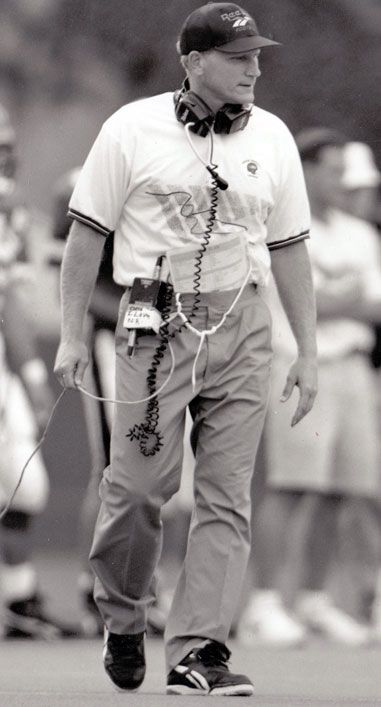
The book was written by Alan Bell , who in the 1980’s was a hotshot prosecutor in Florida. He then left his prosecutor position and took a law firm job in a South Florida skyscraper while he mapped out an anticipated run for the U.S. Senate. But in 1989 he started having bizarre medical symptoms – so bizarre his doctors thought he might have been poisoned by the Mob. Eventually Bell learned that he had been exposed to toxic chemicals in the skyscraper. Bell eventually became so disabled he applied for disability and moved to a remote Arizona location for 8 years to recuperate. Bell then began collaborating with scientists to to raise awareness about environmental toxic exposure. The excerpt in the ABA Journal focused on Bell’s representation of Dan Allen – a successful football coach at College of the Holy Cross in Worcester, Massachusetts[pictured above prior to his death].

In 2001 Allen was working at his office in the gymnasium building at Holy Cross in 2001 when he saw men in white suits and gas masks working on the gym floor. When he asked the workers what they were doing he was advised the gym floor was being resurfaced. Allen asked if he should leave the building[a good question in light of the presence of guys in gas masks] but was advised he would be fine in his office. Shortly thereafter he began to get headaches. Then loss of sensation in a toe. Within 18 months he was in a wheelchair, unable to use his right arm or perform any personal toiletry.

Allen’s wife was a nurse and eventually reached out to Bell. Bell put Allen in touch with Dr. Marcia Ratner, a neurotoxicologist at Boston University. After an examination, Dr. Ratner diagnosed Allen with amyotrophic lateral sclerosis[“ALS”] – otherwise known as Lou Gehrig’s Disease. Allen’s wife then secured the products that were used for the resurfacing in the gym. They included benzene, toluene and isocyanates, all of which were considered ultrahazardous in Massachusetts.

Bell then filed a Workers Compensation claim against Holy Cross and a third party case against the chemical manufacturers. During the course of the third party case it became apparent that the floor resurfacing personnel were obligated by OSHA to wear gas masks and seal off the areas where they were working. Somehow, Coach Allen’s office was included in the sealed area. But Allen continued working in his office without a mask, every moment of which he was being exposed.

Bell then lined up a reknown expert who had studied the link between exposure to the flooring chemicals and ALS in mice. That expert concluded that Allen’s ALS was indeed linked to his exposure.

Lawyers for the manufacturers of course tried to have the case tossed on Daubert grounds – meaning that the science offered by Coach Allen’s lawyers was not generally accepted by the scientific community. U.S. District Judge Dennis Saylor however, denied the Daubert challenge. After that ruling – where a federal court judge had recognized a link between chemical exposure and the triggering of ALS – the manufacturers folded. The case settled in 2009. Unfortunately, by that time Coach Allen had died.

Hats off to Mr. Bell and his team for sticking with Coach Allen and his family.

By Mark Loftus February 17, 2026
German Conglomerate makes a bid to end Roundup litigation 
By Mark Loftus February 17, 2026
By Mark Loftus February 3, 2026
THE ILLINOIS GENDER VIOLENCE ACT - IN A NUTSHELL Under the Illinois Gender Violence Act (GVA) 740 IlCS 82/1, victims of sexual assault, domestic violence and other forms of gender related violence can bring civil actions against perpetrators even when criminal charges are not filed. The GVA defines two of the four acts of “gender violence” - though the definitions are a bit convoluted: One or or more acts of violence of physical aggression satisfying the elements of battery under the laws of Illinois that are committed, at least in part, on the basis of a person’s sex; A physical intrusion or physical invasion of a sexual nature under coercive conditions satisfying the elements of battery under the laws of Illinois, whether or nor the act or acts resulted in criminal charges, prosecution or conviction. Under the Illinois Criminal Code, a person commits a battery when he or she knowingly, without legal justification, causes bodily harm or makes insulting/provoking physical contact with another individual. 720 ILCS 5/12-3. The Criminal Code requires physical contact. AND EMPLOYERS MAY NOW FACE LIABILITY In July, 2023 an amendment made it explicit that the GVA does extend to the workplace. As set forth in the Act, an employer is liable for gender-related violence in the workplace by an employee when the interaction arises out of and in the course of employment. Liability will only arise however, if the (1) the employee was directly performing his or her duties and the violence was the proximate cause of the injury or (2) while the agent of the employer was directly involved in the gender-related violence and the performance of the work was the proximate cause of the injury. Liability will only extend to the the employer however if it can be shown that (1) the employer failed to supervise, train or monitor the offending employee or 2) the employer failed to investigate and respond to reports directly provided to appropriate management personnel. Damages under the Act may include injunctive relief, and actual damages, damages for emotional distress and punitive damages. And importantly, the GVA is a fee-shifting statute - so a successful plaintiff may seek to recover attorneys fees. So, in cases of sexual harassment, may a plaintiff, include a count for damages under the GVA? The answer is an unqualified yes. And the contact need not be excessive or dramatic or prolonged - so long as there was no consent nor any justification for the physical contact. In fact, the Act notes that a legitimate threat that the harasser will commit an nonconsensual act is sufficient.
Red Tesla sedan driving on a road.
September 26, 2025
According to online reports, Tesla ignored a $60 million dollar settlement overture in the wrongful death case that ultimately resulted in a $242 million dollar jury verdict against the car maker. The lawsuit grew out of 2019 crash where a Tesla Model S with Autopilot engaged, plowed through a Florida intersection and crashed into a Chevy Tahoe. Neima Benavides Leon and her boyfriend, Dillon Angulo were standing near the Tahoe when the Tesla crashed into it. Leon was killed and Angulo suffered serious injuries. A lawsuit was filed against Tesla, asserting that although the Autopilot feature was engaged, the vehicle did not brake. Florida law permits a monetary demand to be issued before trial. If the defendant fails to accept the demand within 30 days it is considered rejected. If the plaintiff then goes to trial and secures a verdict 25% greater than the offer, the defendant is on the hook for plaintiff’s investigative expenses and attorneys’ fees. Tesla is appealing the jury verdict, citing “substantial errors of law and irregularities at trial.”.
Johnson's baby powder container, white bottle, blue text, red seal, 400g.
September 26, 2025
This important ruling got kind of lost in the news cycle. A couple weeks ago, the United States Supreme Court refused to vacate a $2.2 billion dollar ovarian cancer verdict against Johnson & Johnson[“J & J”]. The verdict was originally returned by a Missouri jury in 2018 on behalf of 22 women. The original verdict was actually $4.7 billion but a Missouri Appellate Court reduced the award to $2 billion. Each of the women claimed that there was asbestos and asbestos-laced talc in J & J talcum powder products they used, and they developed ovarian cancer as a result. Asbestos is known to cause cancer. Talc, in its raw form is often found in close proximity to naturally occurring asbestos. When J & J mined talc, that talc sometimes contained asbestos. And that asbestos sometimes found its way into J & J personal hygiene products. [In 2019, J & J recalled 33,000 bottles of J & J products after FDA testing found asbestos in test samples]. J & J, has known of the risk of asbestos contamination in talc products since the 1970’s. Some 21,000 plus ovarian cancer cases are pending against J & J throughout the United States.